
Turabian
Honoring Lauryn Kathryn Larimore Turabian (1893 – 1987)

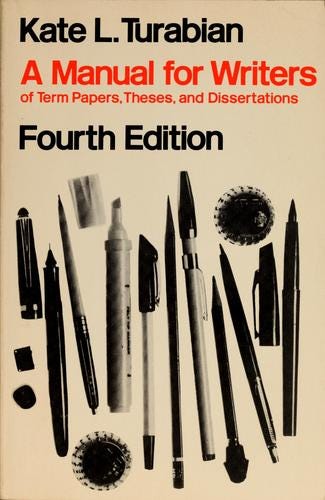
University of Chicago Press, 1973. Now in its ninth edition, also on-line at https://www.chicagomanualofstyle.org/turabian.html.
To my students, I seem most harsh when I insist on including a bibliography or works cited in written work. There is a reason. I can quickly evaluate an assignment by looking at the sources. My eye follows the bibliographic pattern, looking by habit for the author, the title (book title, or article title with journal title), place of publication, publisher, and year. Historians mostly use variations of the Chicago Manual of Style, formalized by Kate Turabian. Her Manual for Writers of Research Papers, Theses and Dissertations is widely used. Along side the manual, one of my favorites studies about citations and patterns is Anthony Grafton’s 1999 Harvard University Press book, The Footnote: A Curious History.
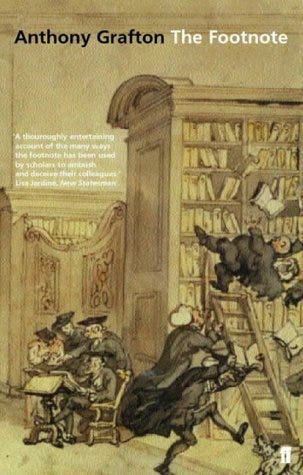
Harvard University Press, 1999.
Turabian and Chicago citation of sources are synonymous because of Kate L. Turabian, the dissertation secretary at the University of Chicago between 1930 and 1958. Because I want to know, I appreciate it when others show me how they know by citing their sources. Turabian’s citation system is foundational. I want to check on the sources, especially the primary sources. How else would I know if I hadn’t lived it? And even as an eyewitness to the past, I would have a limited perspective from just one point of view.
Think of the manicule, the little hand, drawn into the margins with a pointed finger. We also call the pointing finger the index finger. Index, indicate, indicator in English derive from the Latin indicere, which also had the root word dicere – to say. We indicate with an index, saying where we can point ourselves. The notes and bibliographies in history books point me to where I can find out for myself. I’m not so different than the medieval monk who drew a manicula to highlight passages in the manuscript.
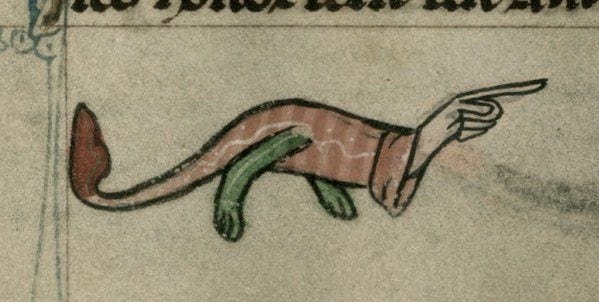
https://news.lib.wvu.edu/2017/08/28/the-first-post-it-note-the-manicule/
Kate Larimore was born in Chicago’s South Side. Her parents descended from immigrants who came to New England in the first migration to the colonies during the 17th-Century migration. Her husband Stephen Gabriel Turabian (1882 – 1967), born in Istanbul, Ottoman Empire, was Armenian – one of many men who left the Ottoman Empire because of persecution.1 In the 1910 U.S. Census, he lived as a boarder in the house of Minnie and Robert Larimore, Kate’ parents. He joined the U.S. military in 1917 when the country joined the Great War in Europe. In 1918, he became a naturalized citizen of the US. He and Kate married in 1919. She was 26 years old. He was 37 years old. In the 1920 U.S. Census, Kate and Stephen continue to live with her parents, and Kate’s two younger brothers, Robert and John. In 1967, Stephen died unexpectedly in Paris while on vacation. Frank B. Kelly, Cice Consul at the U.S. Embassy in Paris completed Form FS1-92, 11-19-51 “Report of the Death of an American Citizen.” The older couple had been staying at the Hotel St. James Albany Hotel on Rue St. Honore. You can check up on me by looking at the digitized sources, archived at FamilySearch.org, ID number L1NL-PY3.
The Chicago Manual of Style can still be purchased as a paper copy, but it’s far more likely to be used in the on-line format. In the “About” pages, I read the following tribute to Kate Turabian – “the University of Chicago has always insisted on the highest standards for the substantive content of dissertations; Kate Turabian enforced the highest standards for the formatting of those dissertations as well. A Manual for Writers has carried her reputation for exactitude well beyond the halls of Chicago.”2
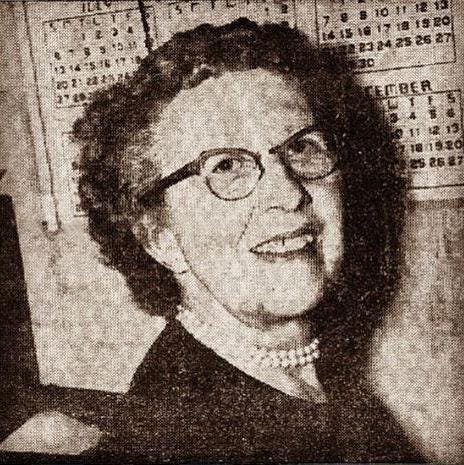
Thank you, Mrs. Turabian.
See “Armenians,” Encyclopedia of Chicago, http://www.encyclopedia.chicagohistory.org/pages/69.html)
I'm delighted to discover that the authoritative Turabian was a Kate. Thanks, Jim!