
Tariff
A word history

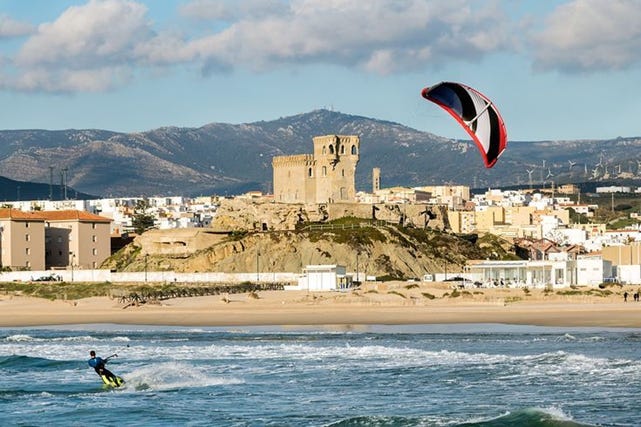
Man kitesurfing on the beach of Tarifa, Spain, Juanamari González, https://www.shutterstock.com/image-photo/man-practicing-kitesurfing-on-beach-tarifa-562875778
Lately, the English word “tariff” has been in the news a lot. As I often do, I wondered about the etymology – the word history. I had visited Tarifa, Spain, the southernmost point of continental Europe. In American History classes, I learned about the disastrous Hawley-Smoot Tariff Act of 1930, that tried to protect American producers during the early years of the Great Depression. Other countries retaliated. American production declined, as did other countries. The depression worsened.
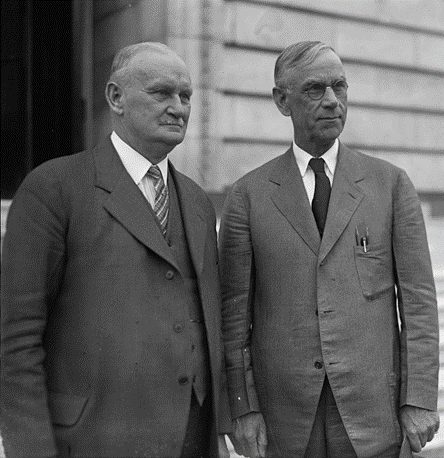
Willis C. Hawley (1864 – 1941), Congressman from Oregon between 1907 and 1933; Reed Smoot (1862 – 1941), Senator from Utah between 1903 and 1933. Both lost their seats in the 1932 election.
Were the places and people connected by the word history of tariff? Not obviously, but I benefitted from the research.
The Oxford English Dictionary, a favorite reference source, defines tariff as “an official list or schedule setting forth the several customs duties to be imposed on imports and exports; a table or book of rates; any item of such a list, the impost (on any article); also, the whole body or system of such duties as established in any country.” As early as 1592, the English Spy Henry Wotton wrote in his letters from Central Europe to William Cecil (1520 – 1598), the chief advisor of Queen Elisabeth I, that “the book that I put to be copied for your Honour is not yet ended, nor the tariffa of all the towns in the Grand Duke's territories, in my hands.” The Etymology page for “tariff” in the OED explains that the English word is a borrowing from the Italian tariffa. Italian, Portuguese and Spanish have the same word derived from the Arabic تعريف (taʿrīf) notification, explanation, definition, article (For more on the Oxford English Dictionary (OED) see the September 3, 2024 post in “History with Jim.”)
But in Spanish, the word for tariff is not tarifa. Tarifa is a place, but it is also the word for fee. An English tariff is a fee, but it is more narrowly, a specific kind of fee or duty on imports and exports. In Spanish that kind of fee on imports and exports is an arancel. The Tesoro de la lengua castellana, o Española compiled by Sebastián de Covarrubias Orozco in 1611, an early printed dictionary of Spanish, defines arancel as “a decree or law that imposes fees on things that are sold.” Covarrubias, also interested in word histories, explained in the arancel entry that the word came from Arabic.
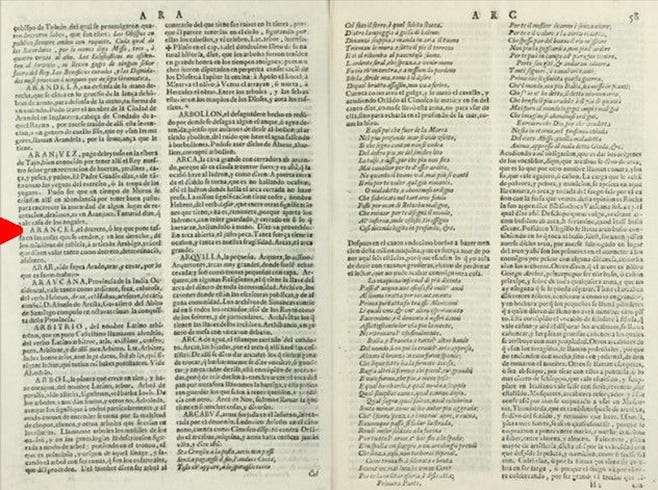
Sebastián de Covarrubias Orozco, Tesoro de la lengua castellana, o española (Madrid: Luis Sánchez, Impresor del Rey, 1611) 57 verso. See on-line https://archive.org/details/tesorodelalengua00covauoft/page/n3/mode/2up
Tarifa – the town in southern Spain – also has an entry in the Covarrubias Tesoro. In 1611, tarifa referred to the town, not a fee. The town was named after Tarif son of Malik, who invaded from Morocco before the main invasion forces of Arabs and Berbers in 711 A.D. The Arabic spelling is طريف (Tarif) – different letters than تعريف. The name translates to exquisite and rare. Here’s an example of different languages, with different phonemes, that merge into one sound in another language. The Arabic ت (t) is different than the Arabic ط (ṭ).
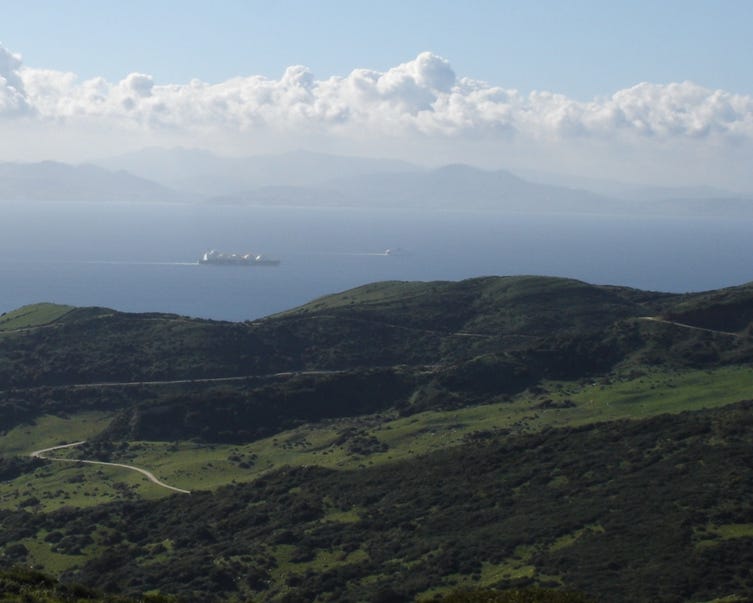
The Strait of Gibraltar, from the hills above Tarifa, Spain; Wikimedia Commons, 18 February 2007
With time, even contemporary Spanish, influenced by Italian and English, defined tarifa as a fixed fee for public services (see the Diccionario de la lengua española, published by the Real Academia Española - https://dle.rae.es/tarifa?m=form#sinonimosZCKWPFd). But that was not always the case. The past was different.
Facts matter, even when confused, conflated, elided or forgotten. Misconceptions are very much tangled webs of our own deceiving. (Shout out to Sir Walter Scott and his 1808 poem Marmion: A Tale of Flodden Field.)