
Precisely Arbitrary

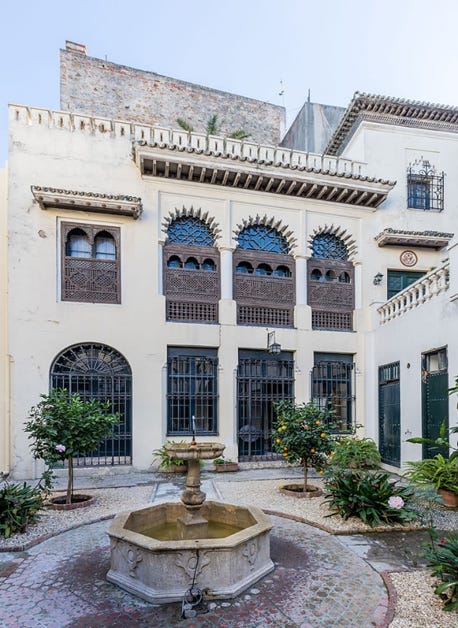
Old American Legation Museum, Tangier, Morocco, Diego Delso, 11 December 2015, Wikimedia Commons, The Tangier American Legation is a building in the medina of Tangier, Morocco. On December 7, 1777 the Sultan of Morocco recognized the independence of the United States of America – the first nation to recognize the U.S.A. The two countries have continued diplomatic relations ever since. The Legation is the only U.S. National Historic Landmark in a foreign country. For more see the Museum’s homepage - https://legation.org/.
Last week on January 1, I concluded that post with a reading recommendation – Stephen Jay Gould’s 1997 book, Questioning the Millennium. The subtitle had the evocative phrase “precisely arbitrary” to describe the countdown to the year 2000 and the problem of Y2K. The two words – precisely arbitrary – help me think about the past. I value precision – the specifics, details and facts. And yet, the arbitrariness and the contingency of life help me remember that answers are best given with replies of “it depends.”
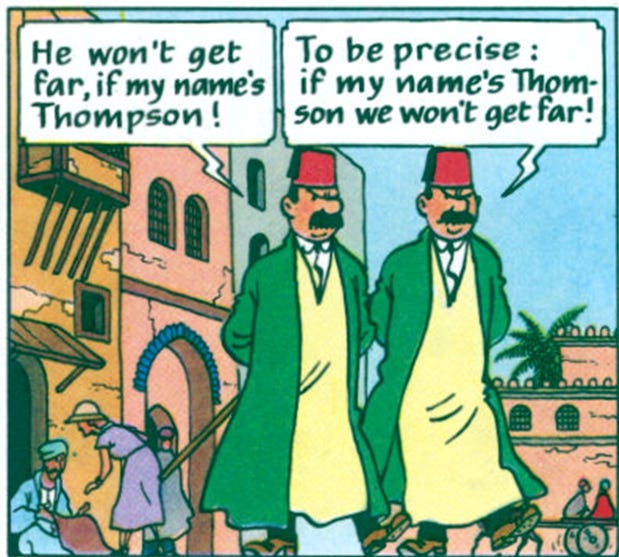
Hergé, Cigars of the Pharaoh: Adventures of Tintin, page 3, frame 13. Les Cigares du Pharaon, 1934, translated by Leslie Lonsdale-Cooper, Detectives Dupont and Dupond (in English Thompson and Thomson).
When asked, for example, “where are you from?” I reply “it depends.” Do they want to know where I now live? Or do they want to know where I grew up? Or do they want to know where I was born? To be precise, I need to know more about the question. I do realize it makes me a bit silly and pretentious, like the cartoon detectives in The Adventures of Tintin, Thompson and Thomson, who always are making mistakes (their verbal turnarounds make me smile). As I continue the conversation, I can explain that I was born in Morocco, my first home was in Tangier, I moved often because of my father’s employment and I have lived in Laie, Hawaii for almost thirty years.
The arbitrary balance appears to be whimsical, unpredictable and random. Life is that way. There were and are so many contingencies. If my father had not been hired by the American Foreign Service and been assigned to the American Consulate in Tangier, Morocco my answers would be very different. Last week’s post about January First and the calendar – roman months, lunar orbits, earth’s circling of the sun, mythological gods – emerged from a precise mix of culture, language, time and people. In hindsight, the contingencies and arbitrary facts matter to the on-going passage of time. Through precise details and explanations of overlaying stories, we all learn about the patchwork world.
That’s one reason I like Gould’s books about biology and natural history. He wrote regular articles for Natural History and dozens of books as a professor of zoology at Harvard University and honorary curator at the American Museum of Natural History in New York City. Here are some other of his books to enjoy:
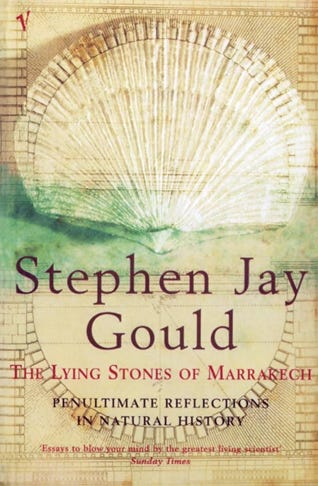
Stephen Jay Gould, The Lying Stones of Marrakech: Penultimate Reflections in Natural History. New York: Harmony Books, 2000.
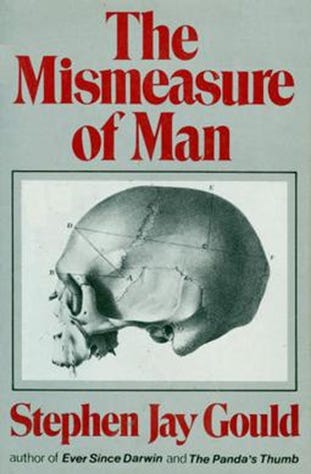
Stephen Jay Gould, The Mismeasure of Man. New York: Norton, 1981.
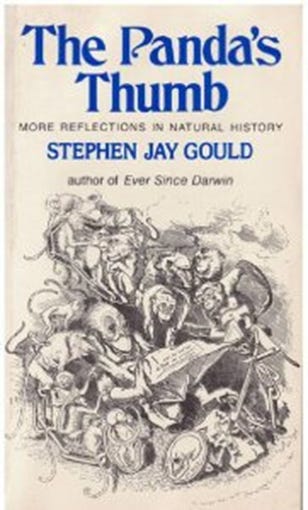
Stephen Jay Gould, The Panda’s Thumb: More Reflections on Natural History. New York: W. W. Norton & Company, 1980.
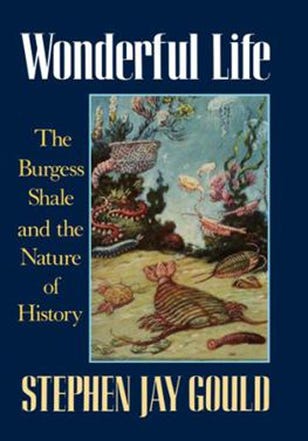
Stephen Jay Gould, Wonderful Life: The Burgess Shale and the Nature of History. New York: W.W. Norton and Company, 1989.