
Book Awards

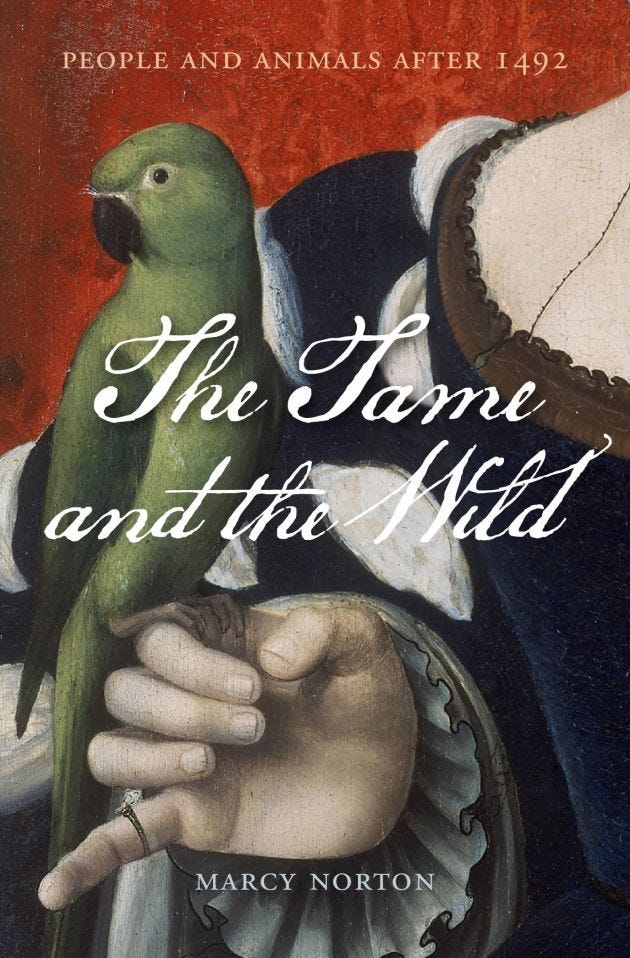
The American Historical Association recently announced its annual book awards. I check the list of winners and make sure I read them. I’ve been reading Marcy Norton’s 2024 book, The Tame and the Wild: People and Animals After 1492. The book won the Friedrich Katz Prize in Latin American and Caribbean History. Norton relates a story told by Gonzalo Fernández de Oviedo (1478 – 1557), the soldier, botanist, writer and historian. He visited the Caribbean islands five times during his life and wrote a general history of the Indies in 1535. The story tells about an indigenous man who abandoned society and lived in a remote part of the island of Hispaniola with only three pigs for company. Columbus had brought pigs on his second voyage in 1494. The indio named them, hunted with them, shared food with them. Indeed, he had trained the pigs to hunt other pigs and so benefitted from their abilities. Sadly, some Spaniards also hunted in the area and killed the man’s three pigs. The death of his porcine companions “brought much pain and suffering to the Indian.” (page 248).
Fernández de Oviedo told the story to consider the rationality and humanity of the indigenous man, defending the indigenous as equal subjects of the King of Spain. But there was a troubling problem of blurred boundaries for the Spanish as they interacted with the people of the greater Amazonia (Caribbean and Amazon basin of South America) and Meso-America (Nicaragua to Mexico). The indigenous man on Hispaniola had tamed the pigs. They worked together hunting other pigs. He became familiar with these three pigs, not raising them as livestock but as friends. The familiarization created equality, even kinship. The man lived with with his companionable pigs, not other humans. Norton writes that this brave, self-emancipated man on Hispaniola inspired this book. (page 333) The tame and the wild connects from the title to the many histories in the 2024 book.
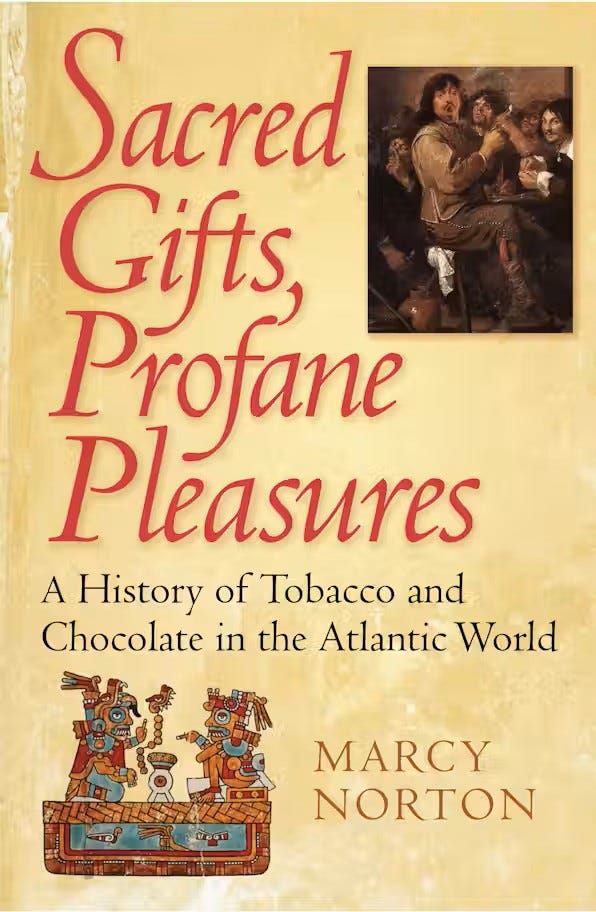
Cornell University Press, 2010.
Like in her first book, Sacred Gifts, Profane Pleasures: A History of Tobacco and Chocolate in the Atlantic World, Norton’s new book helps me think more clearly about the impact of the Columbian Exchange. Yes, there was an immense exchange of animals, people, diseases from the long-time separation of continents, but the “entanglement” has been even more significant. Tobacco and chocolate, subject of Norton earlier book were part of indigenous American cultural systems, embedded within cultural systems. When those products and practices crossed the Atlantic, entering Europe, Asia and Africa, the practices continued but became profaned (no longer sacred) and so became something different – cigarettes and candy. The human relationships with animals chant but the continued legacy of “current ideas and practices around objectifying nonhuman beings are a historical and, therefore, contingent development; we can see that it is our choice to end that practice.” Norton reminds her readers that a powerful benefit of thinking historically is that “what we are used to is” is NOT the only “natural” way. (page 333)
Indigenous writers, among them Kim Tallbear (born 1968) and Ailton Krenak (born 1953) inspire Norton to think about how we fail at “kin-making here, with both humans and non-humans.” We are connected to “birds, rivers, mountains, trees, earth itself” – all subjects, not objects, on our living planet. It’s our only home. (page 332) The last paragraph hopes for a better future without planetary degradation by focusing on “the contagious joy of birdsong, the thrill of seeing a coyote traipse across urban turf or a heron standing with stillness in a city creek, the comfort of nestling with a furry body, the harmony of synchronous walking with a happy dog— these experiences all teach us about our world, if we allow them. They reveal the falsity of the notion that humans can flourish if they look out only for their own interests.” (page 334)
Here’s the list of all the 2025 A.H.A. book awards - https://www.historians.org/perspectives-article/american-historical-association-announces-2025-prize-winners/
"the falsity of the notion that humans can flourish if they look out only for their own interests"--that's it.
Thanks again Jim, Very insightful. We humans not only profane cultural practices but we tend to leave scars during it. Native Americans in the foothills of California were peaceful gatherers and developed a way to make non-edible acorns a stable food. Then we found gold in their hills and employed hydraulic mining to get it. We washed away entire mountains leaving just the rocks. Sad that we allowed it to continue for so long. Love your posts.